
Subtotal $0.00
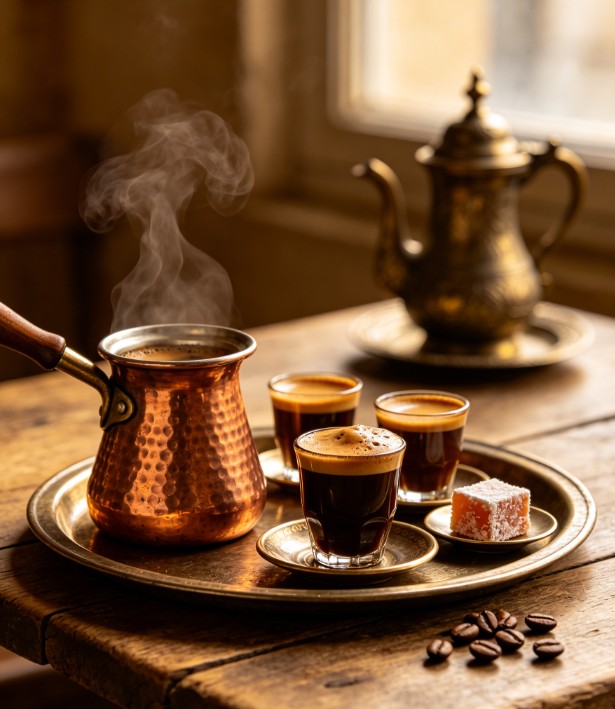
There’s a moment, when the tiny cup is placed before you, that something shifts.
The rich aroma rises. The thick foam sits like a crown on top. And for the next few minutes, nothing else matters. No phones. No rushing. Just you, the coffee, and whoever you’re sharing it with.
This is Turkish coffee. And it’s never just been a drink.
A UNESCO-Recognized Tradition
In 2013, Turkish coffee culture and tradition was inscribed on UNESCO’s Representative List of the Intangible Cultural Heritage of Humanity . It joined the ranks of flamenco, Chinese calligraphy, and the Mediterranean diet as a cultural treasure worth protecting.
Why? Because Turkish coffee combines special preparation and brewing techniques with a rich communal tradition . It’s not about the caffeine. It’s about the ritual.
The UNESCO recognition acknowledges that Turkish coffee is a symbol of hospitality, friendship, refinement, and entertainment that “permeates all walks of life” . An invitation for coffee among friends provides an opportunity for intimate talk and the sharing of daily concerns .
The History: From Ottoman Palaces to Your Table
Turkish coffee’s story begins in the 16th century, during the reign of Ottoman Sultan Suleiman the Magnificent . Legend tells us that an Ottoman governor stationed in Yemen became fond of coffee and introduced it to the palace’s cuisine.
The first coffee house opened in Istanbul in 1554 . It became a hub for social and political activity – a place where people met to converse, share news, and read books . By the late 1800s, there were nearly 2,500 coffeehouses in Istanbul.
And here’s a fascinating twist: during the 1683 Siege of Vienna, Ottoman troops abandoned sacks of coffee after failing to capture the city – inadvertently introducing coffee to Europe . The coffee beans spread across the continent, eventually becoming the global phenomenon we know today.
The Art of Turkish Coffee: How It’s Made
Turkish coffee is unique in the world of coffee. It’s not about speed or convenience. It’s about patience, precision, and care.
The key characteristics:
- Finely ground – Turkish coffee uses ultra-fine powder, even finer than Italian espresso . The texture is akin to all-purpose flour.
- Unfiltered – Unlike American or European coffee, Turkish coffee is never filtered. The grounds stay in the cup and settle at the bottom.
- Brewed in a cezve – The special pot, traditionally made of copper or brass with a long handle, is called a cezve . It has a wide base and narrower neck, ideal for heating water and circulating the grounds.
- Slow and careful – The coffee is brewed slowly over low heat to produce the desired foam – considered a sign of skill and hospitality . The water should never be allowed to boil aggressively.
How to Drink Turkish Coffee: The Ritual
Turkish coffee is always served in small cups, accompanied by a glass of water . The water is used to cleanse the palate before sipping.
The sweetness levels: When you order Turkish coffee, you’re asked how sweet you’d like it :
| Turkish Term | Meaning | Sugar Amount |
|---|---|---|
| Sade | No sugar | 0 teaspoons |
| Az Şekerli | A little sugar | ½ – 1 teaspoon |
| Orta | Medium sugar | 1 – 1½ teaspoons |
| Şekerli | Sweet | 1½ – 2 teaspoons |
Turkish coffee is always served to the eldest person in the room first as a sign of respect . And since it’s much denser than filtered coffee, it’s not customary to drink more than one cup.
The Social Ritual: More Than Coffee
Turkish coffee has never existed solely as a beverage . According to a famous Turkish proverb, “a cup of coffee can create a friendship that lasts for 40 years” .
Here’s how Turkish coffee weaves into daily life:
Wedding rituals: When the groom’s family visits the bride’s house before the wedding, the bride is expected to prepare perfect Turkish coffee . In the past, this was often the only opportunity for the future bride and groom to meet. If the bride was fond of the groom, she would prepare coffee with sugar. If she didn’t like him, she would put salt in his coffee instead . Today, some brides still serve salty coffee to test the groom’s love – if he drinks it without complaint, he passes the test.
Conflict resolution: In Anatolia, coffee served as a means of resolving disputes. When two men fell out in the village, they were served “friendship coffee” to open dialogue and end resentment.
Hospitality: The tradition of Turkish coffee is a symbol of hospitality, friendship, refinement, and entertainment that permeates all walks of life . An invitation for coffee among friends provides an opportunity for intimate talk and the sharing of daily concerns.
Fortune Telling: A Brief Note
One of the most beloved aspects of Turkish coffee culture is fal bakmak – the art of reading coffee grounds to glimpse the future. After finishing your coffee, the cup is flipped onto its saucer, and the patterns left by the grounds are interpreted.
Curious about the symbols and how it works? We’ve written a detailed guide just for you.
Turkish Coffee Today: A Living Tradition
Despite the rise of Western coffee chains in Turkey, Turkish coffee culture is not in danger of extinction. On the contrary, it’s getting very popular, especially among young people.
As Cenk Girginol, author of Coffee: from the Soil to the Cup, says: Turkish coffee is a culture because it has never existed solely as a beverage.
In fact, Turkish coffee was recently registered as a “Traditional Specialty Guaranteed” in the European Union – Turkey’s first traditional product name to receive EU recognition . The unique aroma and taste of Turkish coffee is now protected in Europe.
Turkish Coffee at KAPYA
At KAPYA, we take Turkish coffee seriously. We brew it the traditional way – in a cezve, over low heat, until the foam rises just right.
After your meal, order Turkish coffee and experience the ritual:
- Sade (no sugar) for the pure taste
- Orta (medium sugar) for balance
- Şekerli (sweet) for indulgence
Come for the kebabs. Stay for the conversation. Finish with the coffee.
Contact Details
📍 Find us: 479-1 Wuding Lu, near Jiangning Lu, Jing’an District
🕒 Open daily: 11:30 – 23:30
📞 Reserve: +86-181-0188-1428
📷 Instagram: @kapya_restaurant